


Helmets are designed to cushion and protect your head from the impact of a crash. Wearing a helmet reduces the chance of a brain injury or death. Research shows bicycle helmets can reduce head injuries by about 70% and reduce fatal head injuries by 65%.
Frequently asked questions
Why are helmets important?
What do the stars mean?
Helmet Star ratings show relative protection performance. More stars mean better protection across a wider range of crash situations.
- 5 stars: Outstanding, delivers the highest level of protection measured in testing.
- 4 stars: Excellent, offers a high level of protection in most crash scenarios.
- 3 stars: Superior, performs well across a wide range of crash tests.
- 2 stars: Good, provides better protection than the standard.
- 1 star: Standard, meets the safety standards.
Important: A 1-star helmet is still safe and legal to use. It simply scores lower than other helmets in comparative testing.
How are helmets selected for testing?
Helmets are selected based on their availability in the Australian market, popularity among consumers, and representation across different price points and brands. We aim to test a diverse range of helmets to provide useful comparisons for all types of riders.
Can a helmet with fewer stars still be safe?
Yes. All helmets tested meet Australian and some overseas safety standards, which means they provide a baseline level of protection. The star rating indicates how much additional protection a helmet offers beyond the minimum standard. Even a 1-star helmet is certified safe for use.
How is Helmet STAR different from the Virginia Tech program?
Helmet STAR includes more tests than the Virginia Tech program. Scores and ratings are based on a broader range of criteria, including helmet stability, helmet coverage, reduction in skull fracture, plus brain injury risks and concussion.
Virginia Tech’s star rating is based on oblique drop tests onto a 45-degree anvil and is focused on the assessment of concussion risk.
Helmet STAR performance assessments
| Item score | Tests |
| Coverage | The extent of coverage relative to the AS/NZS 2063 test line |
| Impact energy attenuation drop tests | Drop heights: Low = 800mm (flat and V anvils) Standard = 1500mm (flat anvil) High = 2000mm (flat and V anvils) Tested as per AS/NZS 2512.3.1. Four test sites per helmet, including the side and rear on the test line. |
| Oblique impact test | Test rig and method are conducted similar to those used in the Consumer Rating and Assessment of Safety Helmets (CRASH). Each helmet is dropped twice at two different sites from heights of 1400m for adult helmets and 800mm for child helmets. |
| Dynamic stability | Test as per AS/NZS 2063 using AS/NZS 2512.7.2, Same test load, but tested (a) Front to rear (b) Rear to front. |
| Dynamic strength of retention system | Test as per AS/NZS 2063: 2020 using AS/NZS 2512.5.2. Same conditions (250mm drop). |
| Load distribution | Test as per AS/NZS 2519.9 with 1500mm drop height. AS/NZS 2063 specifies a 1000mm drop height. |
Virginia Tech helmet performance assessments
| Item score | Test |
| Oblique impact test | Helmets dropped onto a 45 degree anvil. Impacts at 6 locations at medium and high impact energies. The head's linear acceleration and angular velocity are measured. Scoring and star rating focus on concussion risk.
|
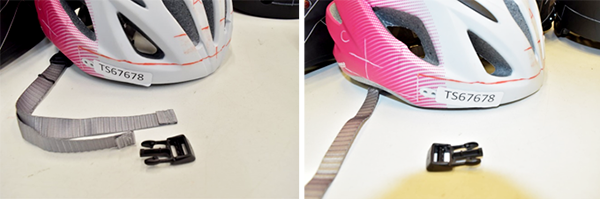
Why is a helmet rated one star if the chin strap and buckle is not permanently attached?
The Australian Standard for bicycle helmets (AS/NZS 2063) requires that all components of the helmet (means of absorbing energy, means of distributing load and retention system) are permanently attached. AS/NZS 2512.1 defines “Permanently attached” as “Not removable except by using a tool or causing damage to the helmet.”
An example is shown below where the male part of the buckle can be undone without the use of a tool. The buckle may fall off and be lost or be put back on incorrectly, meaning the helmet cannot be properly secured and may fall off in a crash.
What is the Angular Impact Management System (AIMS)?
AIMS is a system in helmets designed to reduce brain injuries caused by rotational acceleration (brain rotation inside the skull during impact).
The most common AIMS available in helmets in Australia at present is MIPS. Other systems available internationally include SPIN, WaveCel, ODS and Kineticore.